Leonida Compatibility
Host toolchain check, not a playability chart. Playable is no on every row.
Hosts
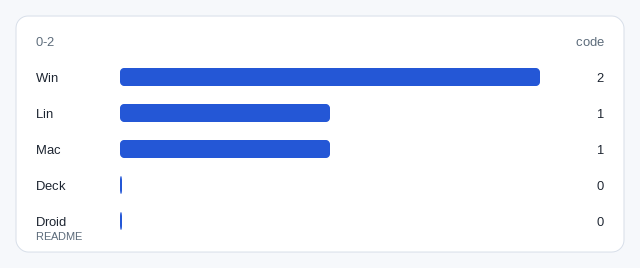
Filter by the toolchain value stored for each host. Native is Windows. Wine is Linux and macOS. not-stated is Steam Deck, because the README never names it. none is Android. Reset restores all five rows.
Full host
Tools native, runtime under Wine
Not named in the README
No toolchain
What each host actually runs
Windows
Windows 10 and 11 x64 is the full host. make_game.py, the asset tools, and the runtime all build on this operating system. The runtime is gta6rt plus the D3D12 to Vulkan layer, and the runtime tests run here with it. The toolchain value on the row is native. Boot and story mode are still blocked, so the playable cell stays no. There is no separate Windows installer next to that source build.
Linux
Linux builds the translator, the asset tools, and the Vulkan GPU test tools as native programs. Those tools have been run on RADV and on NVIDIA. The game runtime is Windows code: it cross-compiles with clang-cl and xwin, and the runtime tests run under Wine or Proton. The game is meant to use that same path, Wine or Proton with the D3D12 layer on native Vulkan. The filter value is wine, and playable is no.
macOS
Apple Silicon runs the Python tools and the Vulkan test tools natively, on MoltenVK from Homebrew or on KosmicKrisp. The runtime remains the Windows build and is started under Wine. The named routes are CrossOver, arm64 with FEX, and x86-64 under Rosetta. MoltenVK has no geometry stage and no VK_EXT_mesh_shader, so those tests are skipped. Subgroups are 32 wide, so wave64 shaders run emulated. Float results differ for PerVertexKHR, NaN compares, negative zero, and NoContraction. Playable is no.
GPU test matrix
Hand-written GPU tests, not a booted game, have results from more than 30 GPU and driver combinations. NVIDIA covers Turing, Ampere, Ada, and Blackwell on Windows and Linux. AMD covers GCN3, RDNA1, RDNA2, RDNA3, and RDNA4 on the Windows driver and on RADV. Intel Gen9 was run under ANV. Apple M1 was run on MoltenVK, which skips geometry and mesh. Mesa llvmpipe is in the same set. Game shaders are checked with spirv-val and with vk_pipeline_check. A wave64 test needs 64-wide subgroups or LEONIDA_W64_EMULATE=1.
No Android build
The README does not list an Android or other mobile build. Android is toolchain none and playable no. There is no official APK. A file named Leonida that asks for an Android install is not from this repository.
GPU notes that are actually in the README
Steam Deck
Steam Deck is not named. The row stays playable no with toolchain not-stated. Do not read a handheld frame rate into that silence. No frame rate is published because the game does not boot.
AMD RDNA
RDNA1, including RX 5000 such as the RX 5700 XT, is a supported shader target. It sits close to the console RDNA2, and its 64-wide subgroups run wave64 shaders natively. RX 5700 XT results pass the GPU test suite. On RADV, pixel shaders without fragment barycentrics have a known difference. On AMD's Windows driver, --wave64-emulate auto keeps native wave64 on RDNA1 and RDNA2 when that GPU can run it, even if vulkaninfo is missing or another GPU is 32-wide, because emulated LDS code can crash that driver. For an RDNA1 card without mesh support, the auto choice uses the compute stage. That note is a test-suite result, not a gameplay result.
NVIDIA and Intel
32-wide subgroups need wave64 emulation for compute and mesh shaders. Cross-half wave ops in vertex, pixel, and geometry shaders stay approximate. --wave64-emulate auto turns emulation on when vulkaninfo does not see 64-wide subgroups.